

Advantages of Foam Insulation

Over the last 20 years, building science research evolved alongside the introduction of various insulation products now available to the construction industry. While some products have changed very little in function, others have altered the trajectory of insulation. Spray Polyurethane Foam (SPF) is one new product that broke the mold.
Perfect for houses, commercial buildings, or any industrial applications, spray foam solves many energy efficiency issues other traditional insulation types cannot solve. With an emphasis on energy efficiency and building science, Foam-One-One has helped hundreds of customers decide on the best path toward energy performance for their residential, commercial, or industrial projects. Here’s how spray foam can fit your next project.
Shields Against Heat Transfer
In short, the purpose of insulation is to slow heat from getting into or out of a building. Spray foam insulation is an effective prevention against the three types of heat transfer: convective, conductive, and radiant. As an air barrier, spray foam insulation prevents convective heat loss associated with air movement through walls and roof lines. The term R-value refers to thermal resistance and measures the resistance level of heat flow a particular material can offer. Spray foam’s effective R-value is a combatant of conductive heat loss. Although spray foam is nothing like a traditional foil-faced radiant barrier, low-density spray foam will not allow heat to ever radiate from its interior facing surface, even with 12-14 hours of direct sunlight on your roof from above.

Deters Moisture and Mold
Openings around pipes and vents let moisture into your home, increasing the humidity. When warm air rises, it lingers in your ceiling and attic, causing mold to grow in places you’ll never see but will cause wood rot and damage. The mold growth can potentially be dangerous for allergy-sensitive home tenants. When other types of insulation get wet, they need to be replaced. Because spray foam expands into every crevice, there is little opportunity for water to get in at all. However, if water does seep in, your spray foam will retain its properties no matter how wet it gets.
Reduces Noise
Much like moisture, sound also crawls in your home through the nooks and crannies. Road noise, loud neighbors, or even media rooms can affect the noise levels. Sealing the gaps around windows, doors, electrical outlets, and plumbing lines will decrease unwanted noises and ensure a more comfortable environment in your home or office.
Quick Installation
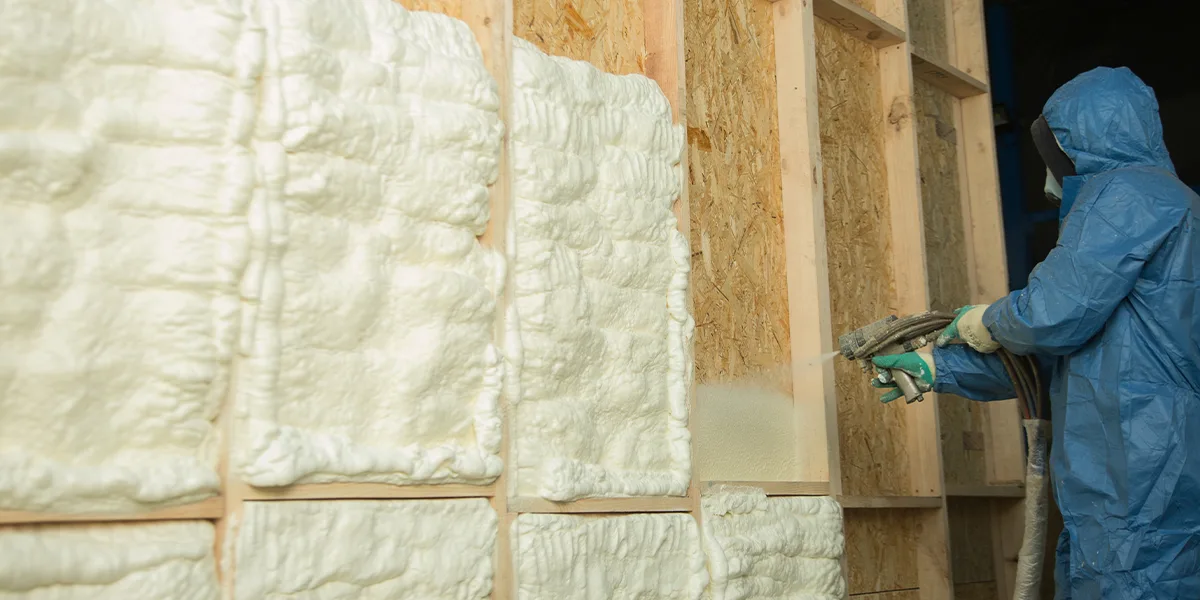
Spray foam insulates and air seals in a single application, providing more than thermal resistance. The finished product is an inert plastic using an integrated adhesive as the attachment. There’s no need for a staple gun or other mechanical fastening system; spray foam expands from a liquid to a solid in seconds. The expansion means spray foam can go almost anywhere, including walls, roof decks, ceilings, sub-floors, rim joists, and any other dry substrate.
Additional Strength
Spray foam requires no extra fastening because it uses its own adhesive to attach to its surroundings. The self-adhesive ultimately means that the foam glues the building materials together, providing more strength to the structure. The foam acts as a barrier from humidity and wind and, in some cases, can be a fire and smoke barrier. Fire needs oxygen and is more likely to spread if the gaps around your pipes are left open.
Is Spray Foam Right For You?
Optimizing your building’s thermal efficiency is the most effective in the planning phase. You should integrate spray foam into your new construction project’s design phase for easy access to walls and roof lines. Contact us today to discuss your new construction project, ensuring proper insulation from the start!